

Grow Your Visibility in Search and AI, Whatever Your Industry
Docket is the AI content platform for hotels and hospitality groups, healthcare, financial services, restaurants, spas and wellness, multi-location brands and agencies. It suggests unlimited topic ideas every week for each website, each scored from evidence, drafts the ones you pick in your voice, checks every draft 450+ ways and publishes to WordPress, now or on a schedule.

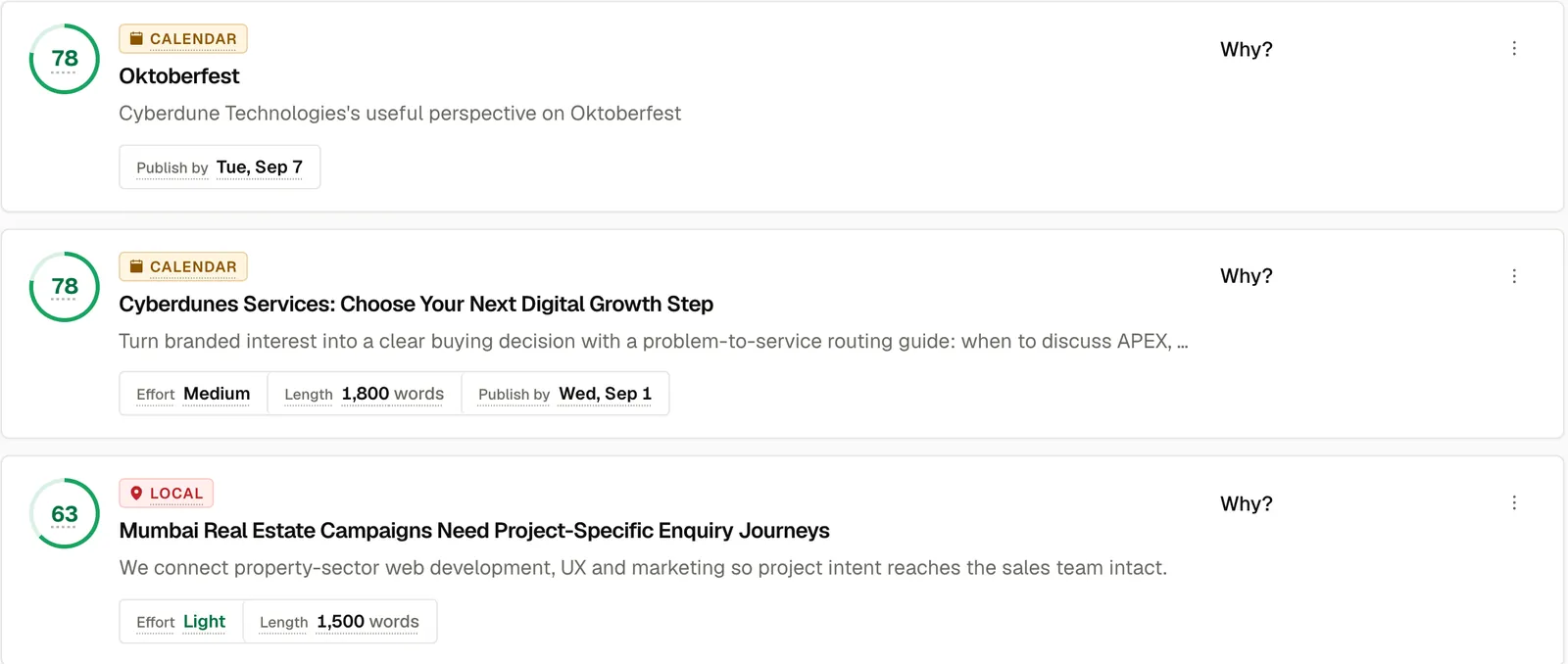
Unlimited Scored Topics, Every Week
Pick the ones you want to write
Which Industries Does Docket Serve?
Marketing leaders whose content drives bookings and enquiries, and who publish on WordPress. Hotels and hospitality groups are where Docket started; each industry below has its own page.

Hotels and Hospitality
For hotel and hospitality marketing teams: seasonal guides planned from 122 dated occasions, a hotel preset that bans “nestled”, and the questions guests ask ChatGPT.

Healthcare Practices and Groups
For clinics and practice groups: required disclaimers, banned terms and banned claims checked before every publish, and what ChatGPT tells patients.

Financial Services Firms
For banks, advisers and insurers: risk warnings checked word for word, promised returns held back, and content planned around tax and year-end dates.

Restaurants and Restaurant Groups
For restaurant marketing teams: Valentine's Day to Christmas party season, planned with real lead times, and what ChatGPT tells diners.

Spas and Wellness Brands
For day spas, hotel spas and wellness groups: gift seasons started on time, treatment claims kept inside your own rules, and what ChatGPT tells guests.

Multi-Location Brands
For franchise and multi-site brands: every location as its own website in one workspace, with its own competitors, calendar and WordPress connection.

Agencies Running Client Brands
For agencies: one website per client, each with its own brand rules, Vault and queue, kept strictly apart.
- Checks on Every DraftSEO, GEO, AIO and format checks
- 450+
- Scored Topics a Week, per WebsitePick and choose what to write
- Unlimited
- Dated OccasionsComputed, never guessed
- 122
- ChatGPT Questions TrackedBy default, and up to 100
- 20
Content Planned From Evidence, in Every Industry
Each topic is scored from your Google Search Console demand, the headroom left, the ChatGPT answers you are missing from, business fit and season. The AI’s own opinion is only a small, capped share.
A topic that would cannibalise a page you already have is heavily penalised, so your queue builds on your site instead of competing with it.
- Unlimited Scored Topics Every Week, Across 6 Search Intents
- Marked Provisional When the Evidence Is Thin
- Near-Duplicates of Your Site and Queue Rejected
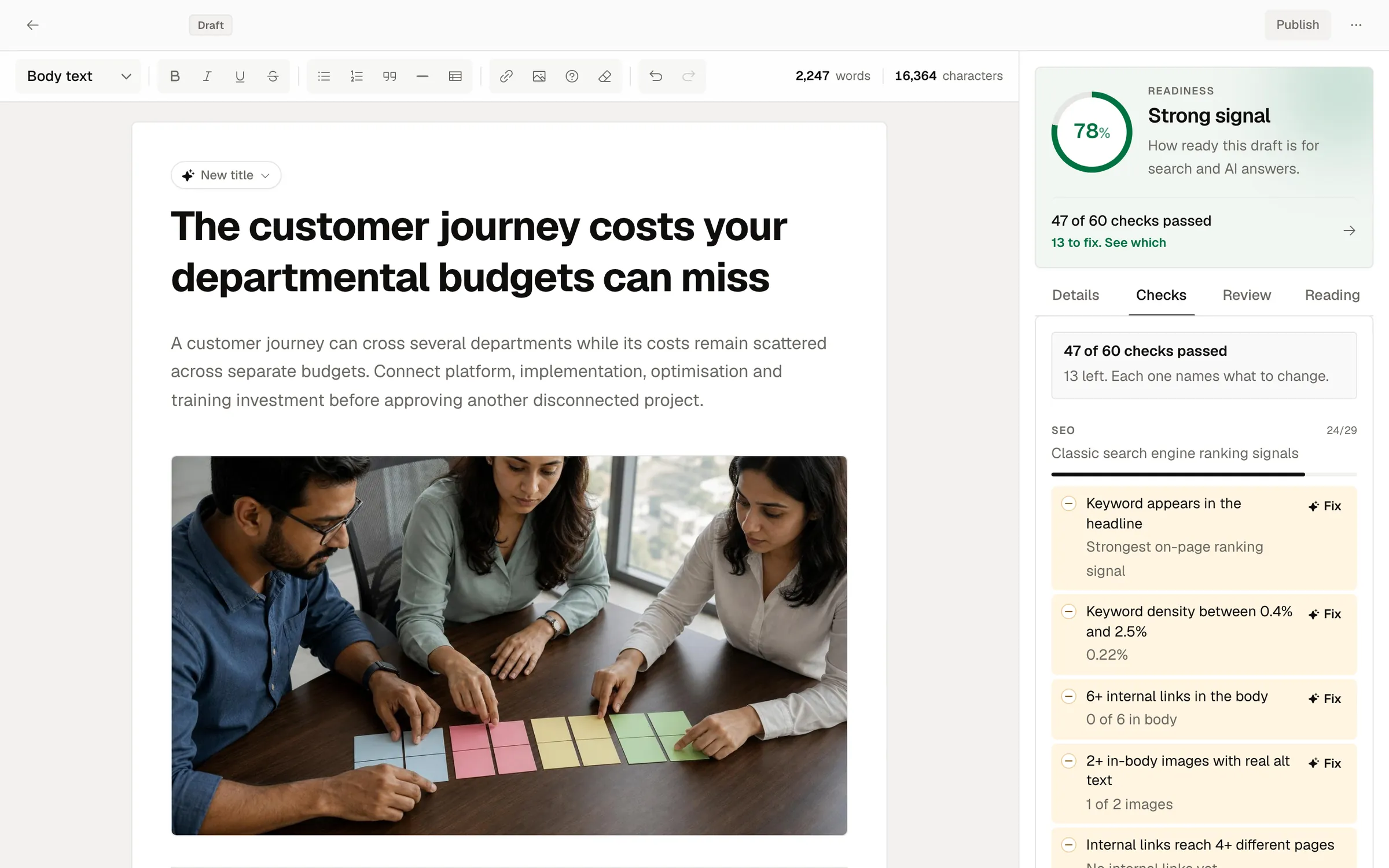
Every Draft Graded by the Same 450+ Rules, Whatever Your Industry
Every draft is checked against 450+ rules across SEO, GEO, AIO and format. Same article, same score, every time.
GEO (generative engine optimisation) is writing so an assistant can quote you. AIO (AI Overview optimisation) is structuring a page so a summary can lift it. Both live in the glossary.
- Most Checks Have a One-Click Fix, and No Fix Invents a Statistic
- Advisory: The Checklist Never Blocks Your Publish
- Up to Two Repair Passes by a Separate Reviewer Before You Open It
Industry Content Marketing, Planned, Written and Checked
| Topic | The Usual Way | With Docket |
|---|---|---|
| Choosing Topics | The Usual Way: A keyword export, a hunch and whoever talked longest. | With Docket: Scored from your Search Console demand and the ChatGPT answers you are missing from. |
| Seasonal Content | The Usual Way: Remembered the week it was needed. | With Docket: 122 dated occasions, each started on its own lead date. |
| Brand Voice | The Usual Way: A tone-of-voice PDF last opened in 2019. | With Docket: Up to 6 sentences lifted word for word from your own site. |
| Optimisation | The Usual Way: A review after the writing is finished. | With Docket: 450+ checks on screen while you write. |
| Publishing | The Usual Way: Copy, paste, re-upload the images, hope. | With Docket: Sent to WordPress with images, schema and the SEO plugin fields your site exposes, then read back. |
| Going Live | The Usual Way: Whoever has the login and a free afternoon. | With Docket: Publish now or on a schedule, with brand safety rules checked first. |
Is Docket the Right Fit for Your Team?
It fits teams that publish to WordPress and want evidence behind every topic, with their own brand rules enforced on every post.
Docket Fits If
- You publish to WordPress and want every post to arrive complete, images and SEO fields included.
- You want to show up in ChatGPT's answers, as well as in Google's links.
- You run more than one website, each with brand rules of its own.
- You want one editorial standard that scores every draft the same way.
How Docket Works With You
- Brand safety rules are checked before anything goes live, on every post, instant or scheduled.
- Every article goes to WordPress as a post, with every field read back.
- ChatGPT is measured with live web search, so every reading reflects what buyers see.
- Positions and traffic come straight from your own Search Console and GA4.
- Facts come from your Vault and your own business details, the material you provide.
Every safeguard is set out in full on the security page and each product page.
AI Content by Industry: Your Questions, Answered
Who is Docket for?
Docket is for marketing leaders at organisations whose content drives bookings and enquiries and who publish on WordPress: hotels and hospitality groups first, then healthcare practices, financial services firms, restaurant groups, spas and wellness brands, multi-location brands and agencies running client websites. Setup offers 15 industry presets, with Hotels & Hospitality first.
Does Docket work for regulated industries like healthcare and financial services?
Yes. Docket checks your banned terms, banned claims and required disclaimers before every publish, and a broken rule blocks the publish, every time. Healthcare and financial services teams write their own rules, can make a fact check against their own business details mandatory, and can limit approval to workspace owners.
Can Docket manage more than one website?
Yes. Each website in Docket has its own brand rules, competitors, Vault, WordPress connection, Google properties, topic queue and library. Websites sit inside a workspace, and everyone in that workspace sees every website in it. A workspace holds the owner plus up to 3 people.
Which CMS does Docket publish to?
Docket publishes to WordPress posts only, through the REST API with an application password. It sends the title, body, excerpt, slug, featured image, categories, tags and the Yoast SEO, Rank Math or SEOPress fields your site exposes over REST, then reads every field back so you see exactly what saved.
Does Docket measure every AI assistant my buyers use?
Docket measures ChatGPT today, and measures it in depth. It asks ChatGPT, with live web search, the questions your buyers ask, and records whether you were named, who was named instead and which sources were cited, so every reading reflects what buyers actually see.
Which Docket plan fits a hotel, an agency or a multi-location brand?
Basic ($99 a month) suits a single hotel, practice or restaurant with one website. Pro ($299 a month) covers three websites, such as a small group or an agency's first clients, and adds Insights and page audits. Enterprise is priced for larger portfolios and multi-location brands, with custom limits and several workspaces.
Can I try Docket on my own website first?
Yes, with the free AI visibility check. Enter your domain, and Docket asks ChatGPT three real buyer questions and shows whether you were named and who was named instead. It needs no account, and the full product is set up with your team after a demo.
Does Docket work for websites in other languages?
Docket is tuned for English-language content. The checklist and readability rules are written for English, so it does its best work on English-language sites, with each site's calendar filtered by its own region.
See Docket on Your Own Website
Book a demo with your own domain on the screen: the topics Docket would plan for your industry, the checks a draft would face and what ChatGPT says about you today.