

Never Run Out of Content Ideas That Drive Traffic
Docket's AI content planning gives marketing teams an unlimited weekly supply of ranked topics across six search intents, scored from your own Search Console demand, ChatGPT answers and brand fit. Every article your team writes starts with a reason, and the evidence behind it is on screen.
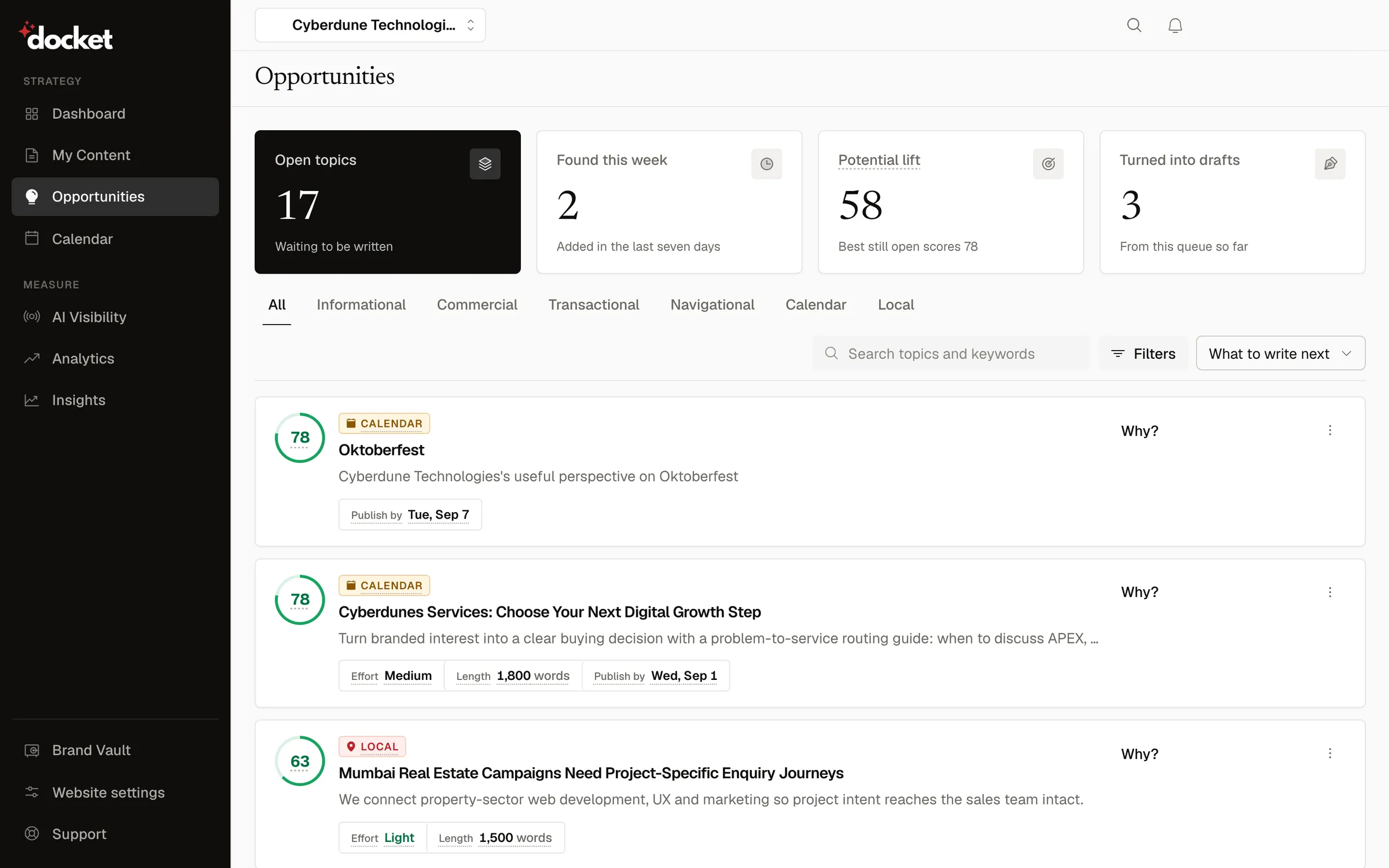
A Content Calendar Built From Evidence, Every Week
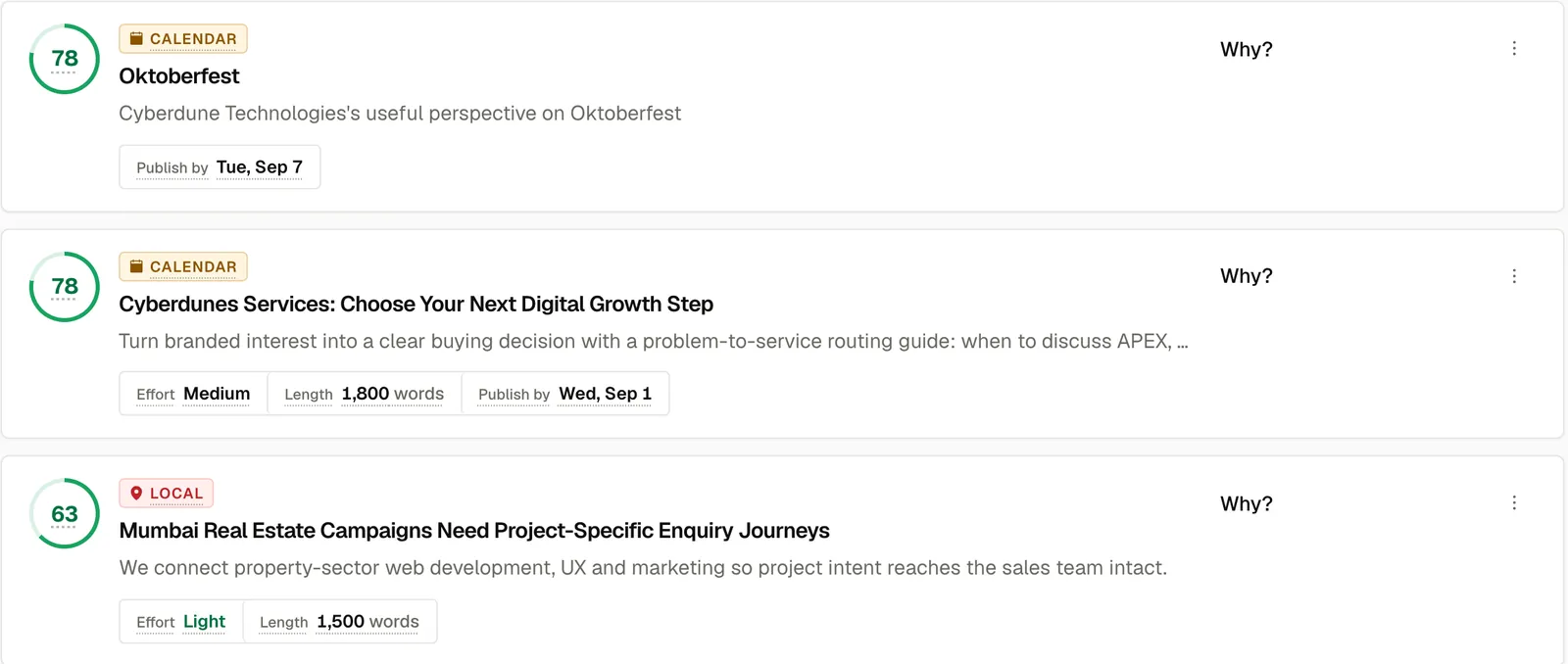
Every topic arrives with its intent, its score, what the score rests on and what it needs from you.
Unlimited Topics, Every Week
Scored topic ideas across six search intents, per website. Pick the ones you want to become articles.Scores Built From Evidence
Search Console demand, the position you hold, ChatGPT answers you lose, fit and season. Computed, not asked of a model.Scores That Show Their Confidence
A signal with no evidence is dropped, not scored as zero. Thin evidence caps the score and marks it provisional.Protects the Pages You Have
A topic that would cannibalise a page you already have is heavily penalised. Near-duplicates are rejected outright.Effort You Can See
Light, one input or heavy, read from the brief. Material in your Vault lowers the band.Dates That Are Calculated
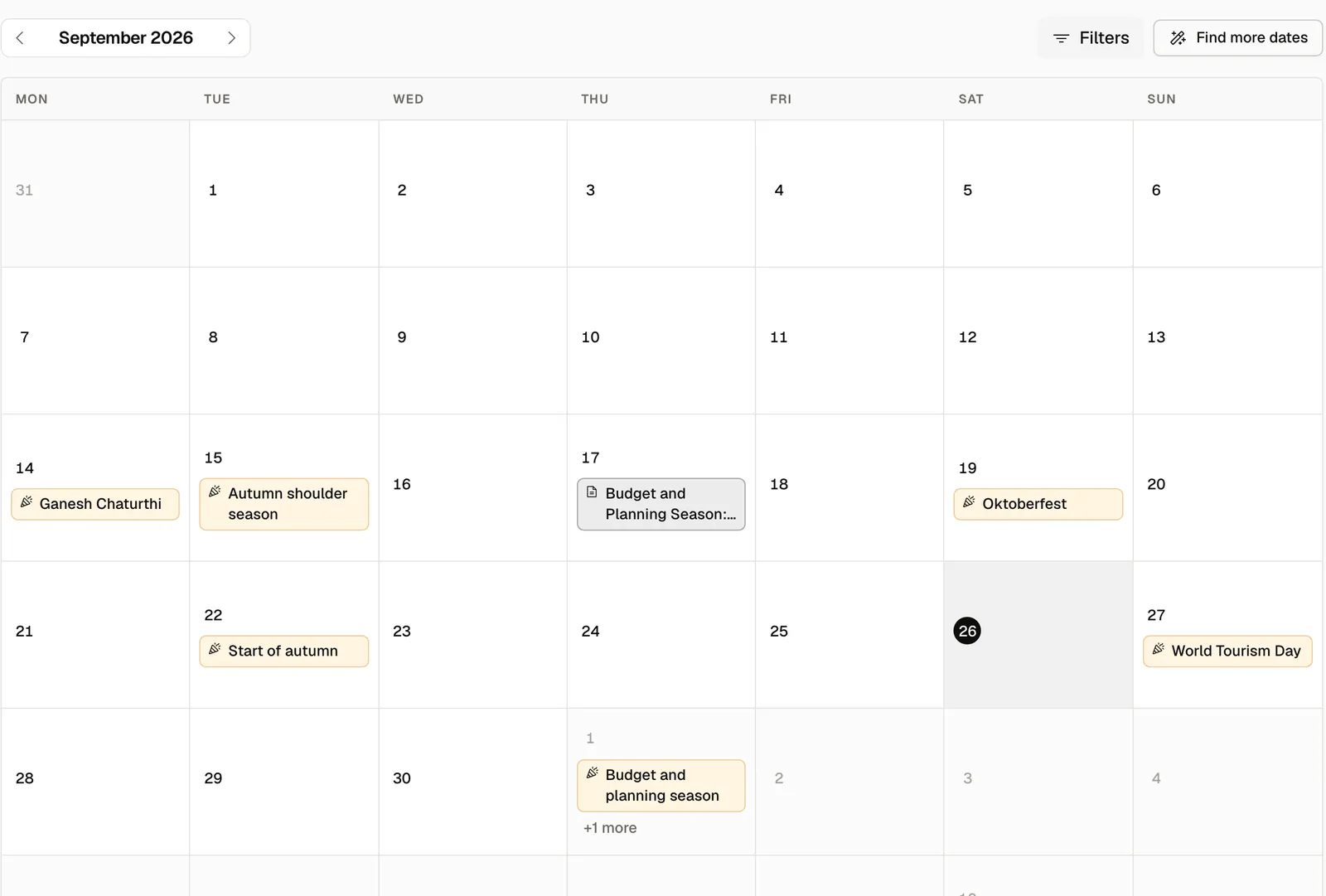
122 occasions with computed dates. Moon-dependent ones are flagged for you to confirm.
How Does Docket's AI Content Planning Choose Topics?
Docket proposes a week of topics, checks every candidate against real evidence, then computes a score from 0 to 100. The AI suggests. The evidence decides.
- 01 · Plan
A Week of Ideas
Topics are drawn from your brand profile, Vault, recent titles, the Search Console queries you nearly rank for, and questions ChatGPT answered without you. - 02 · Ground
Checked Against Reality
Each candidate is checked against your published pages, ChatGPT results and the Vault. Near-duplicates of the queue, the site or the batch are rejected. - 03 · Score
Scored on Evidence
Signals without evidence are dropped. Thin evidence caps the score, so nothing scores 100 on a hunch, and a score built on too little data says provisional. - 04 · Queue
Only the Ones That Pass
Weak topics are not queued. Quick wins on the dashboard are the strongest topics that are also ready to write.
Six Intents, Three Topics Each, Every Week
A balanced queue reaches every kind of buyer. The mix is fixed, so every kind of search intent gets its three.
- 3InformationalPeople learning about a subject.
- 3CommercialPeople comparing options before they choose.
- 3TransactionalPeople ready to buy or book.
- 3NavigationalPeople looking for you by name.
- 3CalendarDemand tied to a date or a season.
- 3LocalDemand tied to a place.
Topic Scores Built From Evidence, Not Guesswork
Docket computes the score itself, from signals it can point to, so every number arrives with its reasons and two topics can be compared on the evidence.
The answer-engine term comes from what ChatGPT says about you. The demand terms come from Search Console.
- Demand From Your Own Search Console, Balanced So One Giant Query Cannot Drown the Rest
- Headroom, Answer-Engine Loss and Business Fit, Each From Data You Can Inspect
- Season on Dated Topics Only, and Every Topic Scored Out of 100
- A Heavy Penalty for Cannibalising a Page You Already Have
AI Content Planning vs the Keyword Spreadsheet
| Topic | The Usual Way | With Docket |
|---|---|---|
| Choosing Topics | The Usual Way: A keyword tool, a brainstorm and whoever spoke last. | With Docket: Unlimited scored topics every week, planned from your own site, Search Console and ChatGPT answers. |
| Scoring | The Usual Way: A number from a model, with no reasons attached. | With Docket: Weighted signals from evidence. AI judgement is a small, capped share. |
| Missing Data | The Usual Way: Filled with a guess, or a zero that looks like a finding. | With Docket: Dropped, capped by a ceiling and labelled provisional. |
| Duplicates | The Usual Way: The same idea, reworded, every quarter. | With Docket: Rejected against the queue, the site and the batch. |
| Your Existing Pages | The Usual Way: A new post that quietly competes with an old one. | With Docket: Cannibalising a page you have is heavily penalised. |
| Seasonal Dates | The Usual Way: Looked up by hand, often after the booking window opens. | With Docket: 122 computed occasions, with a start date and a live date per topic. |
A Planner That Works From Your Evidence
Designed so every topic in the queue is one your team can defend.
Demand From Your Own Data
Demand comes from your Search Console, so scores reflect your real audience rather than a third-party estimate.You Choose What Gets Written
An unlimited weekly supply of ranked topics. Pick and choose which become articles.Useful From the First Week
Before Search Console is connected, topics are scored on fit and judgement and labelled provisional. Connecting it read-only strengthens every score.Every Date Checked
Fixed and rule-based dates are computed exactly. Moon-dependent dates such as Diwali and Eid are flagged for you to confirm. See seasonal planning for hotels.Outcomes on the Record
Each article is measured at 30, 60 and 90 days and stored beside its prediction. See how measurement works.
Questions About Topics and Scoring
What should my business write about?
Docket answers that every week with an unlimited supply of ranked topics for your website across six search intents, drawn from your own Search Console queries, questions where ChatGPT named a rival instead of you, your brand profile and the dated occasions in your market. Each topic shows its score, what the score rests on and how much input it needs from you, so you pick the ones you want.
Can Docket do keyword research from Search Console?
Yes. Docket reads your Search Console queries with read-only access and plans topics around those ranking 4th to 20th, where a focused article has the most room to move. Search Console demand and headroom then feed each topic's score, so your plan rests on your own audience's searches rather than a third-party estimate.
How does Docket find content topics?
Docket offers unlimited topic ideas every week for each website, across six search intents, drawn from your brand profile, your Vault, your recent titles, Search Console queries ranking 4th to 20th, and questions where ChatGPT named a competitor instead of you. Every candidate is then checked against real evidence before it is queued.
How is the opportunity score calculated?
The score runs from 0 to 100 and is computed from evidence, not taken from a model. It weighs Search Console demand, the headroom left above your current position, answers where ChatGPT named a rival, business fit and, for dated topics, season. AI judgement is only a small, capped share. A topic that would cannibalise one of your pages is heavily penalised.
What happens when there is no data for a signal?
A signal with no evidence is dropped from the score, not counted as zero. Thin evidence then caps the score so it cannot reach 100, and when too little of it was measured, the score is labelled provisional on screen.
What are the six search intents Docket plans for?
The six intents are informational, commercial, transactional, navigational, calendar and local. Docket plans topics for every intent each week, so no type of buyer goes missing from the plan, and you choose which become articles.
Will Docket suggest topics that compete with pages I already have?
Docket works to prevent it. A topic that would cannibalise a page you already have is heavily penalised in its score. Near-duplicates of your queue, your live site or the same weekly batch are rejected outright, so the same idea in different words does not come back.
Do I need Google Search Console for topic suggestions?
No, but the scores are stronger with it. Search Console supplies the demand and headroom signals. Without it, those terms are dropped rather than guessed, the score is capped because the evidence is thin, and it is marked provisional. Docket reads Search Console with read-only access.
How are seasonal topics dated?
Seasonal dates are calculated, never guessed by a model. Docket holds 122 dated occasions, filtered by region and industry. Fixed and rule-based dates and Easter are exact. Moon-dependent dates such as Diwali and Eid come from a table and are flagged for you to confirm. Each topic gets a start date and a live date.
What is an effort band on a topic?
An effort band says how much a topic needs from you. Light means Docket can finish it alone. One input means you supply one fact. Heavy means it needs an interview, a permission or original data. Bands are read from the brief, and matching material in your Vault lowers the band.
See a Scored Week of Topics for Your Own Site
We walk through your queue on a call: what each score rests on, and what it would take to write it.